
Church leaders weighing solar panels for churches face a practical question before a spiritual one: will panels on this building cut what the congregation pays for electricity, and how would a tax-exempt organization pay for them? Grant lists rarely answer either.
We start with three site questions: how much power the building uses, where panels can go, and whether the electrical service can take them. The utility’s rules then shape the design, and funding questions, including any tax credit, go to the church’s tax professional to confirm.
Key Takeaways
- Whether solar works for a church depends first on the site: annual electricity use, usable surface facing south if possible, and an electrical service that can take solar without upgrades.
- An unusable sanctuary roof does not end the project, because carports over the parking lot can be set at the ideal angle and roof work can be planned before panels.
- On California’s net billing tariff (often called NEM 3), a design that simply covers 100% of usage is no longer the default answer; utility rules change, so confirm the current tariff.
- Grants for church solar are limited and change often, so treat them as a supplement and build the case on bills, financing and confirmed incentives.
- Test every proposal against 12 months of the church’s own bills, confirm the company is the actual installer, and check the rate escalation assumption behind the savings.
Do Solar Panels for Churches Make Financial Sense?
Solar saves a church money by replacing electricity it would otherwise buy from the utility. A sanctuary, offices, a fellowship hall and perhaps a school or daycare wing all draw power, and those bills come out of the same budget that funds ministry.
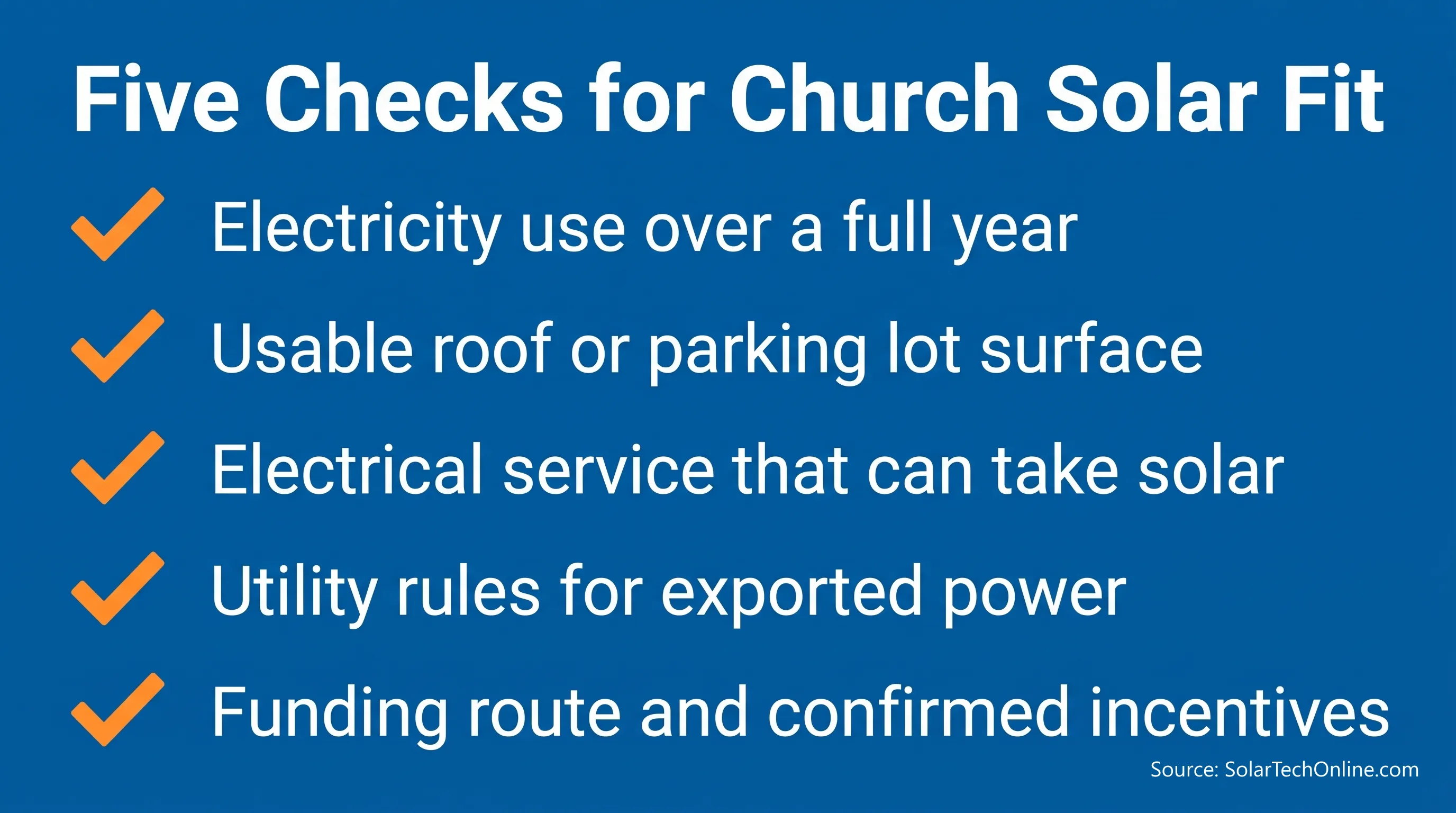
Tax-exempt status alone does not make solar pay. The answer for solar panels for churches turns on five factors, each covered below:
- Electricity use: how much power the buildings draw over a year, and when.
- Usable surface: roof area or parking lot space with good sun, ideally facing south.
- Electrical service: whether the existing service can take solar without upgrades.
- Utility export rules: what the utility pays for power the system sends back to the grid.
- Funding route: cash, loan, a power purchase agreement (PPA) or lease, plus any incentives the church can confirm.
Many congregations also see solar as stewardship, and that is a valid reason to start the conversation. The financial case should still stand on the bills, because a finance committee will rightly ask whether the project pays for itself.
Synagogues, mosques and temples that own their building can use the same site checks and questions as a starting point, and their accountant can confirm which incentives apply.
Three Things That Decide Whether a Church Property Fits
A church can size up its own campus before calling anyone. On the commercial sites we assess, three factors decide the outcome: the building’s power use, the surface available for panels (south-facing is best), and an electrical service able to accept solar as it stands. Skipping upgrades that aren’t needed holds the project cost down, and that lower cost is what lets the savings add up.
Electricity use
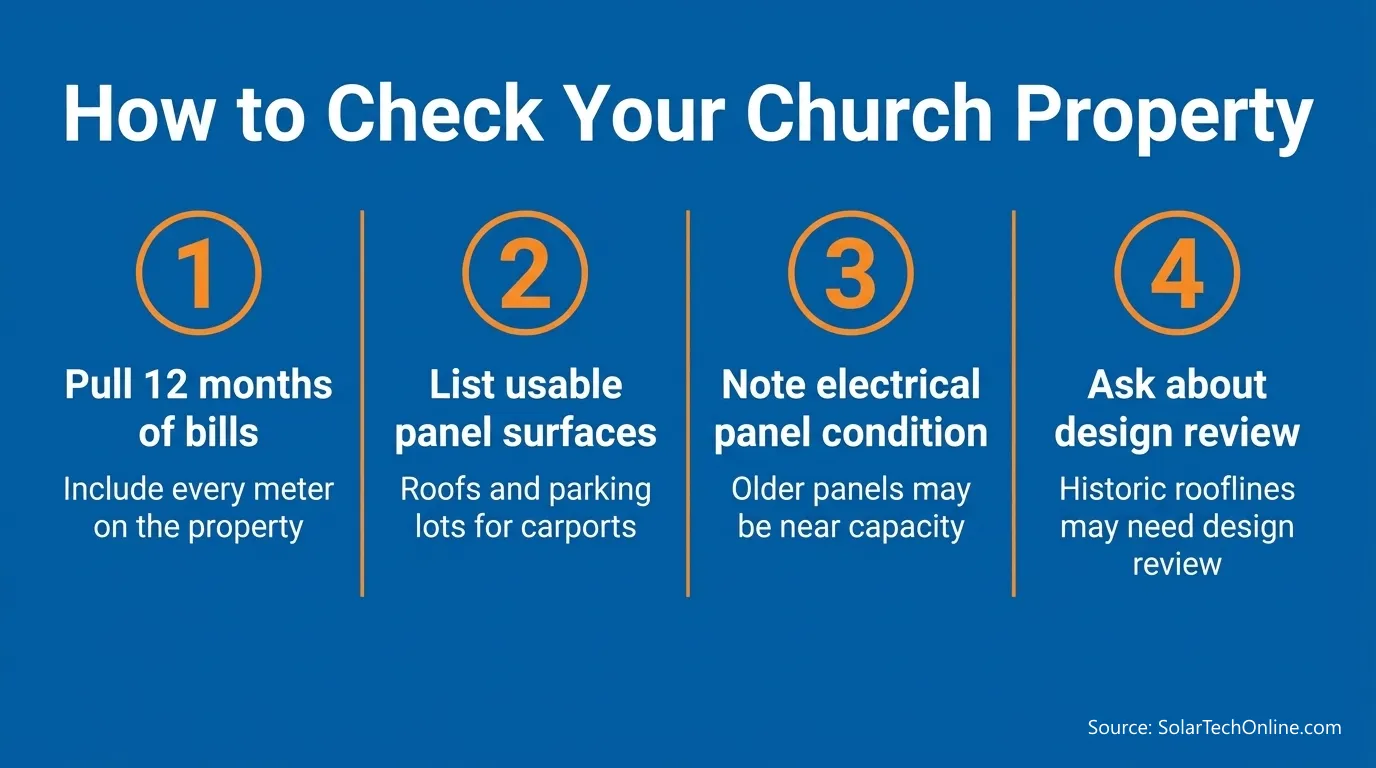
Pull 12 months of utility bills for every meter on the property. Look at the total, then at when the building uses power: weekday office hours, evening classes and events, Sunday services, and any school or daycare wing. That timing matters as much as the total once utility rules come into play.
Usable surface
The most visible roof is not the only option. List every surface that could hold panels:
- The sanctuary roof
- The fellowship hall or education building
- School or office buildings on the same campus
- Parking lots, which can hold carports
South-facing areas with little shade from trees, steeples or neighboring buildings are the strongest candidates.
Electrical service
Older church buildings may have electrical panels close to capacity. Note the age of the panels and any breakers that trip during large events, so the survey checks them rather than someone discovering a problem mid-project.
For a historic or architecturally prominent roofline, local design or historic review can apply. Ask the city or county permitting office early what review a visible array would need.
What our assessment covers
Our free commercial site assessment combines satellite imagery with an on-site evaluation of available space, sun exposure, roof condition and electrical infrastructure, so surface, sun and electrical capacity are checked on site, alongside the bills you provide.
When the Roof or Electrical Service Isn’t Ready
Many church roofs are old, steep, shaded or simply too important to the building’s look. That does not settle the question. Two routes let a weak site still work: carports, and electrical upgrades packaged into the project. Roof condition is settled before either.
Roof condition comes first
On the roofs we survey, the first call is what the roof needs before any panels: nothing, a repair or a complete replacement, and occasionally whether it should carry solar at all. Roofing material also changes how mounts are attached and waterproofed. On the foam roofs common around Palm Springs, for example, our installers place the mounting posts first and a roofing specialist follows to make each one watertight.
Because SolarTech also does roofing and checks roof condition during the assessment, roof work and the array can be planned together instead of as two separate surprises. Our crews are in-house, with no subcontractors.
Carports when the roof can’t be used
When a roof can’t be used, we build carports instead. A carport can be set at the ideal angle for production, which suits churches with large parking lots, and it gives shade to members on Sunday.
This case shows how a property with an unusable roof still went solar at low cost, because carports took the array and the existing electrical service needed no upgrades.
Electrical upgrades folded into the project
If the building does need electrical work, that work can be folded into the solar project as part of the same job. Where an upgrade also fixes existing electrical problems, the church gets both benefits in one job. Any tax benefit on the upgrade depends on the project, so a tax professional should confirm it.
You can run the same check yourself: if the roof is doubtful, measure the parking area, and ask whether the existing service can take the system as it stands.
How Your Utility Shapes System Size and Battery Needs
Before sizing anything, we look up the church’s utility, because its export rules set the size and whether a battery pays. Utility rules change, so confirm the current tariff before signing.
California net billing
The CPUC’s net billing page explains that since April 15, 2023, customers applying for interconnection take service on the net billing tariff (often called NEM 3) under D.22-12-056, with exports credited at a rate reflecting their value to the grid. The original customer is guaranteed the tariff for nine years.
On California NEM 3 utilities, a system built large to send surplus to the grid no longer pays back, because those exports now earn far less. That shift favors pairing panels with a battery that holds midday output for pricey evening hours, while the church buys grid power when rates are at their lowest. Under NEM 2, by contrast, the biggest system covering 100% of usage paid back fastest.
| Utility | Export credit basis | Battery role |
|---|---|---|
| SCE, PG&E, SDG&E (California) | Net billing: exports valued at their worth to the grid | Often a large share of the savings, depending on when the church uses power |
| APS (Arizona) | Resource Comparison Proxy (RCP) rate set for each annual tranche | Compare daytime load and rate plan before adding storage |
Arizona (APS)
The APS RCP rate rider sets $0.05554 per kWh for the tranche running September 1, 2026 through August 31, 2027, and the rate may not be reduced by more than 10% each year.
Because exports are credited at this fixed tranche rate rather than the retail price, compare the church’s daytime load and rate plan before adding storage.
Matching the system to church hours
Church load patterns make this matter:
- Sunday morning services draw heavily, but midday production on a quiet Sunday afternoon may be exported at low value.
- Weekday offices use power while panels produce, which is the best match.
- Evening classes, choir practice and events fall after sunset, where a battery storage system can supply stored power.
Compare these hours against the church’s rate plan before deciding on size and storage.
How a Tax-Exempt Church Can Still Get Incentive Value
A church pays no income tax, so a tax credit sounds useless. Elective pay changes that. The IRS elective pay guide for tax-exempt organizations states that organizations recognized as exempt under sections 501 through 530 are eligible to make an elective payment election, filed on Form 990-T with the form required for the credit. It also notes that the property must be placed in service before a registration number is issued.
Timing is tight. The SEIA and Wood Mackenzie Q3 2025 report explains that a solar project starting construction on or before July 4, 2026 has at least four years to come online, while projects starting after that date must be placed in service by the end of 2027 to be eligible for the 48E credit. Eligibility is never guaranteed, and the full rules are covered in our article on commercial solar tax credit deadlines.
What we do first
Because tax benefits drive solar economics, the question we raise first with a church or nonprofit is whether the IRS can pay it the credit directly. Tax advice is outside our role, so we coordinate with the church’s accountant and provide the project numbers they ask for. Commercial tax benefits are ending and rules change, so a tax professional should confirm what applies.
Questions to bring to the accountant:
- Does the church qualify as an applicable entity for elective pay?
- Can the project begin construction or be placed in service within the current deadlines?
- What registration and filing steps does the church need, and when?
- How would a grant or other funding affect the amount claimed?
Under a PPA, a third party owns the system; ask the church’s accountant how that affects any incentives.
Grants and Other Funding Sources for Church Solar
Solar-specific grants for churches are limited and change often. Treat any grant as a supplement to a project that already makes sense on bills, not as the reason to proceed.
California’s battery incentive shows how fast programs move. A CPUC proposed decision on SGIP states that all ratepayer budgets were set to close to new applications on December 30, 2025. Check the current status of any local utility rebate before counting on it.
Places to look
- State and utility programs: search the DSIRE database for California or Arizona and filter for nonprofit eligibility, then confirm details with the program itself.
- Denominational funds: ask your regional body or conference office whether it offers church loan funds or creation-care grants.
- Local foundations: ask community and family foundations whether they fund capital projects for congregations.
For program-by-program detail, see our guide to solar grants for businesses and nonprofits.
Before applying, run this checklist:
- Confirm the grant accepts houses of worship.
- Check whether it must be awarded before construction starts.
- Read the reporting requirements after the award.
- Ask the accountant whether the grant reduces the cost basis used for other incentives.
Paying for the Project: Cash, Loans, PPAs and Leases
A congregation can own the system or let someone else own it. The choice decides who keeps the long-term savings, and the church’s accountant should confirm how it affects any incentives.
| Route | Upfront cost | Who owns it | Who maintains it |
|---|---|---|---|
| Cash purchase | Full project cost | The church | The church, often under a service agreement |
| Loan | Little or none | The church | The church |
| PPA | Little or none | Third-party owner | The owner |
| Lease | Little or none | Third-party owner | The owner, per contract |
Under a PPA, a third party owns the panels on the church property and the church buys the power they produce at an agreed rate. This suits congregations without capital. Contract terms vary, so read the price escalator and the end-of-term options closely.
Ownership keeps the full savings and lets the church pursue elective pay itself. Blended funding is common, such as a capital campaign plus a loan, or a grant plus ownership. Plan board approval with the credit deadlines in mind, and review our nonprofit and municipal solar page.
How to Compare Church Solar Proposals
A finance committee can run the same checks on every quote it receives. These are the points we would want a church to verify:
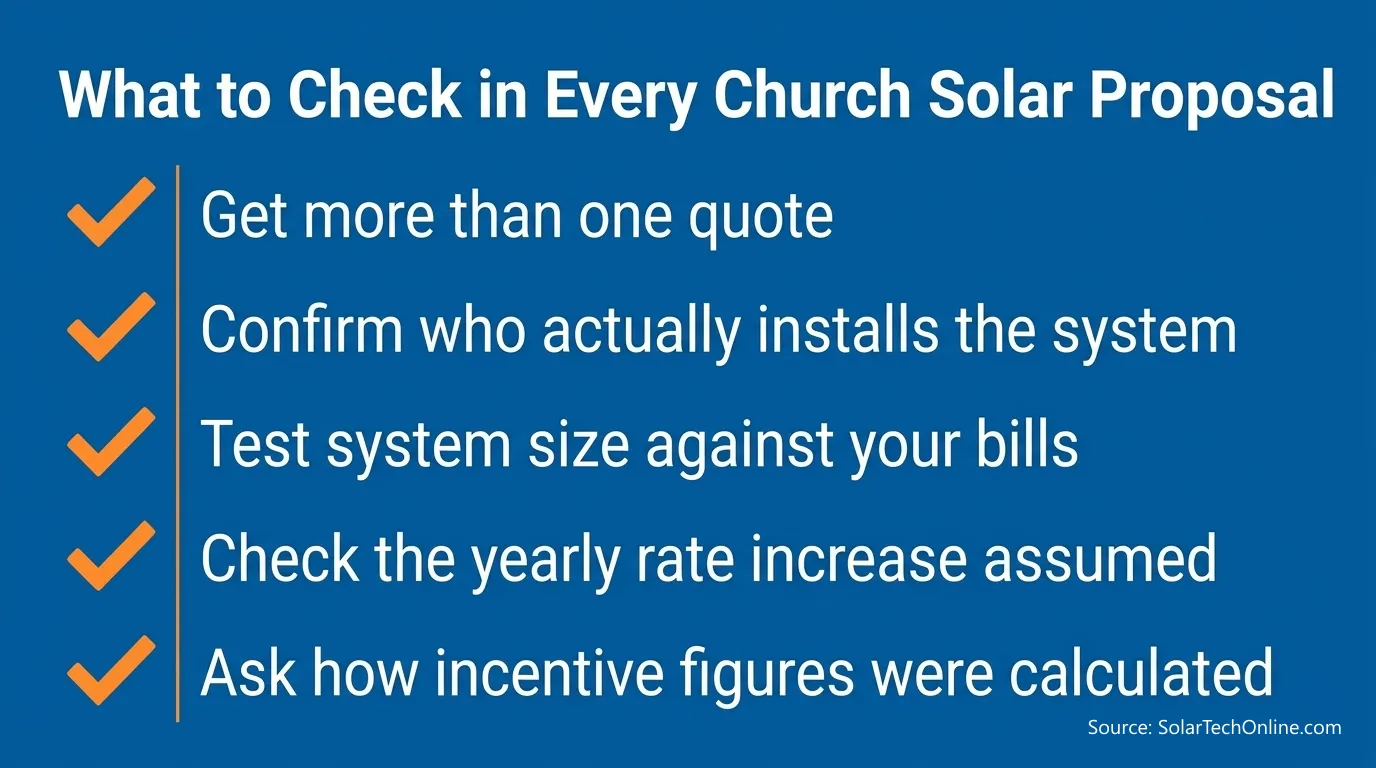
- Get more than one quote. Comparing proposals shows which assumptions stand out.
- Confirm the actual installer. Ask whether the company selling the system is the one installing it, or whether it hands the work to someone else.
- Test the size against your bills. Compare each proposed system size with the church’s own 12 months of usage plus planned changes, such as a new building, EV chargers or added events. On NEM 3, surplus output earns little at the grid, so being locked into a long lease on a system that is too big can drain money for 25 years.
- Check the rate escalation assumption. Find the annual rate increase the proposal assumes. The CPUC’s solar consumer protection guide caps it at 10% as of 2025 and reminds customers that bill savings estimates do not guarantee savings. Separately, our own proposals assume 4% a year, which we consider cautious given recent increases at California’s three large utilities, though rate history varies by utility and tier and future rates are not guaranteed. The higher the assumption, the bigger the projected savings look, so ask why any figure above 4% was chosen.
- Ask who does the roof and electrical work. The proposal should say whether the survey covered roof condition and panel capacity.
- Ask how incentive figures were calculated. Have the accountant check any credit or elective pay assumption.