
Home Energy Storage
Home Battery Storage for California and Arizona Homes
Store the solar you produce during the day and use it when rates peak or the grid goes down. SolarTech has installed home batteries across Southern California and Phoenix for 25 years, in house, start to finish.
Years In Business
Projects Completed
5-Star Reviews and Testimonials
In-House Service Team
Warranties
RESOURCES
The savings come from storing solar, not selling it
California changed how utilities pay for exported solar in April 2023. Sending power to the grid at midday now earns a fraction of what it used to, while you still buy it back at full peak rates in the evening. A battery closes that gap by holding your production until you actually need it.
If you are on SDG&E, SCE, or PG&E and interconnected after April 14, 2023, you are on the Net Billing Tariff. Storage is what makes the numbers work.
~75%
20 years
4 to 9 pm
Full retail
How It Works
How solar battery storage works in your home
Your panels, your battery, and your utility meter work as one system. Here is the daily cycle.
01
Your panels produce
Midday sun generates more electricity than your home is using. That surplus has to go somewhere.
02
Your battery charges
Instead of exporting surplus for a low credit, the system routes it into your battery first.
03
You discharge at peak
From late afternoon into the evening, your home draws from the battery instead of buying expensive grid power.
04
You stay on during outages
When the grid drops, the battery takes over automatically. Your panels recharge it the next day.
What it means at home
Three things a battery actually changes
Backup you do not have to think about. Wildfire shutoffs, storm outages and rolling blackouts stop being an event. The transition is automatic and your refrigerator, lights, WiFi and medical equipment keep running.
A lower bill during peak hours. Every kilowatt-hour you pull from the battery between 4 and 9 pm is a kilowatt-hour you do not buy at the highest rate of the day.
Real energy independence. Pair enough storage with the right array and most of your consumption comes from your own roof rather than the utility.

Compare Our batteries
Tesla Powerwall 3 & Enphase
SolarTech is a certified installer of the top choices for home batteries. The right one depends on your roof, your panel setup, and how much of your home you want backed up.
Whole home, one unit
Tesla Powerwall 3
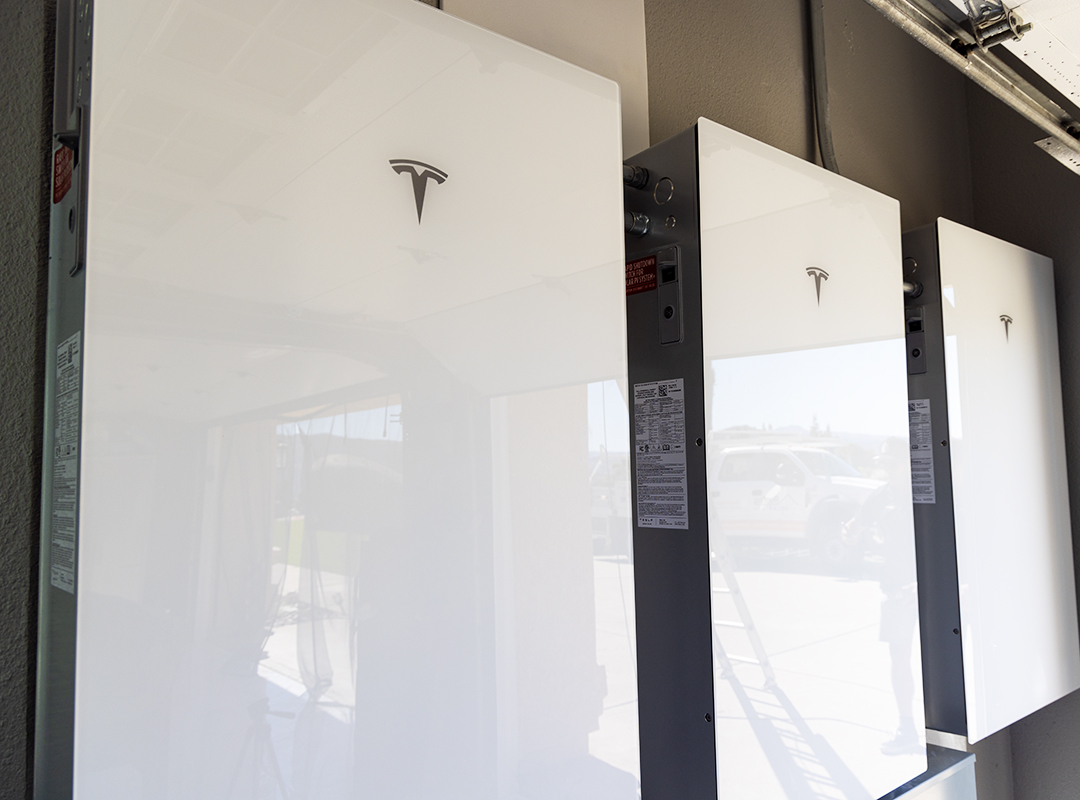
The simplest path to backing up an entire house. A single Powerwall 3 carries heavy loads that used to require two batteries.
Start small, grow later
Enphase IQ
Built in modules rather than one large box. Start with the capacity you can afford now and add more as your usage changes.
| Comparison | Tesla Powerwall 3 | Enphase |
|---|---|---|
| Known for | Whole-home backup from a single unit | Modular capacity you can add to |
| Design approach | One larger battery with the solar inverter built in | Several smaller units working together |
| Chemistry | Lithium iron phosphate (LFP) | Lithium iron phosphate (LFP) |
| Growing later | Add more Powerwall 3 units | Add one module at a time |
| Monitoring | Tesla app | Enphase app, with panel-level data |
| Good fit if | You want the whole house covered and the simplest install | You want to start smaller or already run Enphase microinverters |
Scroll to compare
Capacity, output and warranty vary by model within each brand. We size the system to your actual usage and confirm exact specifications on your proposal.
Cost and financing
What a home battery costs
Every quote is built around your actual usage and setup, so the number is real rather than a starting point that moves. Loan, lease, PPA, or cash purchase. We will show you what each one looks like for your home
$0 down
Start without paying anything upfront. Loan payments are often structured to sit below what you already pay your utility.
Four Flexible Options
Start without paying anything upfront. Loan payments are often structured to sit below what you already pay your utility.
Battery Only
Already have panels? You can finance storage on its own without bundling it into a whole new system.
Already have solar
Adding a battery to a system you already own
You do not need to replace your panels to add storage. We retrofit batteries onto existing arrays regardless of who installed them, including systems on older inverters and other brands.
If you are grandfathered on NEM 2.0, adding storage does not automatically move you to NEM 3.0. We will confirm how your specific interconnection is handled before anything is submitted.
GET A SAVINGS ESTIMATE
Researching Size & Price?
Use our solar calculator to get an instant estimate. See your projected monthly savings, system size, and 25-year return based on your actual home. No obligation. Just a quick estimate.

Why SolarTech
We handle every step with our own crews
Design, permitting, installation, inspection, and interconnection all run through SolarTech. No subcontractors, no handoffs, one company accountable for the system.
Battery installation across California and Arizona
Licensed in both states. CA Lic# 1106777 · AZ Lic# ROC 343417.
TESTIMONIALS
Thousands of satisfied customers
Hear from our satisfied customers and why they choose SolarTech for their roofing and solar services.
4.6 out of 5 stars based on 1572 customer reviews.

Find out what a battery does for your bill
Join thousands of homeowners already saving with SolarTech. No pressure. Just a free, no-obligation consultation.
15,000+ homeowners have already made the switch.
- 100% In-House Installation
- 25-Year Solar Warranties
- Serving Homeowners since 2001
Prefer To Talk? Give us a Call
(619) 743 9193
Home battery storage FAQs
Do I need a battery to make solar worth it in California?
For systems interconnected after April 14, 2023, effectively yes. Under NEM 3.0 the credit you earn for exporting solar is roughly 75% lower than it was under NEM 2.0, while the rate you pay for evening power stayed high. Storage lets you keep your production instead of selling it cheap and buying it back expensive. Solar-only still works for some usage profiles, and we will show you both models rather than assume.
How much does a home battery cost?
We quote battery cost per home rather than publish a range, because the honest answer swings widely depending on how much of your house you want backed up, how much capacity you need, and whether your electrical panel needs work first. A range published on a website would either be too wide to be useful or too narrow to be true for you. What we will commit to is a complete number with nothing excluded, including permits, inspection, and interconnection, plus a walk-through of every financing path so you can see what the monthly payment actually looks like. Request a quote, and you will have real figures for your address.
Is the 30% federal tax credit still available for batteries?
Not for homeowner-purchased systems. The Residential Clean Energy Credit under Section 25D ended for property placed in service after December 31, 2025. If you installed in 2025 you can still claim it on that year’s return. Third-party owned systems such as leases and PPAs may still access a federal credit, but the owner claims it, not you. We are not tax advisors, so confirm your situation with your CPA.
Can I finance a battery on its own, without buying panels?
Yes. Our loan option supports battery-only financing, so homeowners who already have solar can add storage without bundling it into a whole new system. We will walk you through every payment structure we offer and show you what each one looks like month to month before you commit to anything.
Can one battery power my whole house during an outage?
It depends on the battery and your loads. A Tesla Powerwall 3 delivers 11.5 kW continuous, which is enough for whole-home backup in many houses including air conditioning. Modular systems are often configured for essential circuits first and expanded later. During the site visit we measure your actual loads and tell you what a given configuration will and will not carry.
How long do home batteries last?
Manufacturer warranties in this category generally run 10 years or more, and the lithium iron phosphate batteries we install are built for a longer service life than conventional lithium-ion. Capacity declines gradually over time rather than failing outright. We will show you the exact warranty terms for whichever battery ends up on your proposal, and our monitoring service tracks performance so you are not guessing about system health.
How long will a battery run my home?
A 13.5 kWh battery covering essential loads typically runs a home overnight and often longer. In a multi-day outage your panels recharge the battery each day, which is why solar plus storage outlasts a generator with no fuel run. Runtime depends entirely on what you are powering, so we model it against your utility usage data.
Can I add a battery to solar panels another company installed?
Yes. We retrofit storage onto existing arrays from any installer and most inverter brands. Compatibility depends on your current inverter, so we start with a system health check. See upgrades and additions for how retrofits work.
Will adding a battery move me off NEM 2.0?
Not automatically. Systems interconnected before April 15, 2023 are grandfathered on NEM 2.0 for 20 years, and adding storage within certain limits generally preserves that status. The rules turn on your specific interconnection agreement and how much capacity you add, so we verify with your utility before filing anything.
Are home batteries safe to install indoors?
Modern residential batteries are designed for wall mounting in garages and along exterior walls. Lithium iron phosphate units from Enphase use chemistry that is highly resistant to thermal runaway. Every install is permitted, inspected, and code-compliant with your local jurisdiction, and we handle that paperwork.